

On this page
- When does lagoon sludge become a problem?
- What is lagoon sludge made of?
- How does in-place sludge reduction work?
- How much sludge can you remove without dredging?
- Should you treat sludge in place or dredge?
- How do you measure lagoon sludge?
- How Triplepoint reduces lagoon sludge in place
- Frequently asked questions
Lagoon sludge can be reduced in place, without dredging, by giving bacteria enough oxygen and mixing to digest the organic (volatile) part of the sludge aerobically. In-place reduction works best before sludge causes permit violations, and studies with combined fine and coarse bubble aeration have averaged 45–50% sludge reduction. Grit and sand do not digest and still have to be removed mechanically.
Key takeaways
- Lagoons are built to store sludge in the bottom 1–2 feet; problems start when it builds past about 18–24 inches.
- Only the volatile fraction (dead bacteria, algae, organics) can be reduced in place. Sand and grit must be dredged.
- Oxygen plus full water-column mixing is what digests sludge; aeration that leaves dead zones lets it keep building.
When does lagoon sludge become a problem?
Most wastewater lagoons are partial-mix or facultative systems designed to store sludge, so they go years, often about 20, between cleanings. Once sludge builds past design storage, usually 18–24 inches, it starts to cause problems:
- Lost capacity. A 10-foot lagoon with 4 feet of sludge is effectively a 6-foot lagoon, with shorter retention time and less treatment.
- Benthal feedback. Digesting sludge releases BOD, TSS, ammonia and phosphorus back into the water, sometimes pushing effluent ammonia above influent.
- Odors and floating sludge. Anaerobic digestion makes gas, including hydrogen sulfide, that lifts sludge mats to the surface, especially during spring and fall turnover.
- Low dissolved oxygen and, eventually, permit violations.

What is lagoon sludge made of?
| Component | Examples | Can it be reduced in place? |
|---|---|---|
| Volatile (organic) solids | Dead bacteria, algae and duckweed, paper and other complex organics | Yes, by aerobic digestion |
| Non-volatile (inert) solids | Sand, silt, grit, insoluble metals | No; must be removed mechanically |
The split matters. A core sample tested for total solids (TS) and volatile solids (VS) tells you how much of your sludge blanket is digestible, and therefore how much in-place treatment can remove.
How does in-place sludge reduction work?
Without oxygen, sludge digests anaerobically: slowly, with odors, and often more slowly than new solids arrive, so the blanket keeps growing. When oxygen and mixing reach the bottom, aerobic bacteria break organic solids down much faster and without odor.
- Measure the sludge. Survey depth across the lagoon and test core samples for volatile solids.
- Fix aeration first. Repair or replace failed blowers, laterals and diffusers.
- Mix the full water column. Aeration has to reach the bottom and leave no quiet zones where sludge drifts collect.
- Add bioaugmentation if needed. Bacteria blends can speed digestion, but only with good aeration.
- Screen the influent so grit, rags and wipes stop adding to the inert layer.
- Re-survey every year to confirm sludge depth is falling.
How much sludge can you remove without dredging?
It depends on how much of the sludge is volatile and how well the lagoon is mixed. Sludge reduction studies with dual-action fine and coarse bubble aeration, the approach used by Ares Aeration®, have averaged 45–50% reduction. Lagoons with mostly organic sludge see the most benefit; lagoons full of grit see less.
Even when a lagoon will eventually need dredging, reducing the organic sludge first shrinks the volume to dewater, haul and dispose of, which is where most dredging cost sits.
Should you treat sludge in place or dredge?
| If… | Then… |
|---|---|
| Sludge is building but effluent still meets limits | Reduce it in place with aeration and mixing |
| Sludge is past design storage and limits are at risk | Dredge, then fix aeration and mixing so it does not return |
| Most of the sludge is sand, grit or inert solids | Remove it mechanically and add influent screening |
| You are planning an aeration upgrade anyway | Design it to mix the full water column and cut future dredging |
For dredging methods, dewatering and recent cost examples, see Lagoon sludge removal: dredging vs. treating sludge in place.
How do you measure lagoon sludge?
Take a sludge survey at least once a year; many permits require it after five years of service. The most common tool is a sludge judge, a clear 2-inch pipe with a check valve that shows the depth of the sludge blanket and pulls a core sample at the same time. Take 12–36 depth readings across the lagoon, depending on its size, plus about 12 cores for lab analysis, and measure from fixed benchmarks so results compare year to year.
Step-by-step: How to perform a lagoon sludge survey.
How Triplepoint reduces lagoon sludge in place
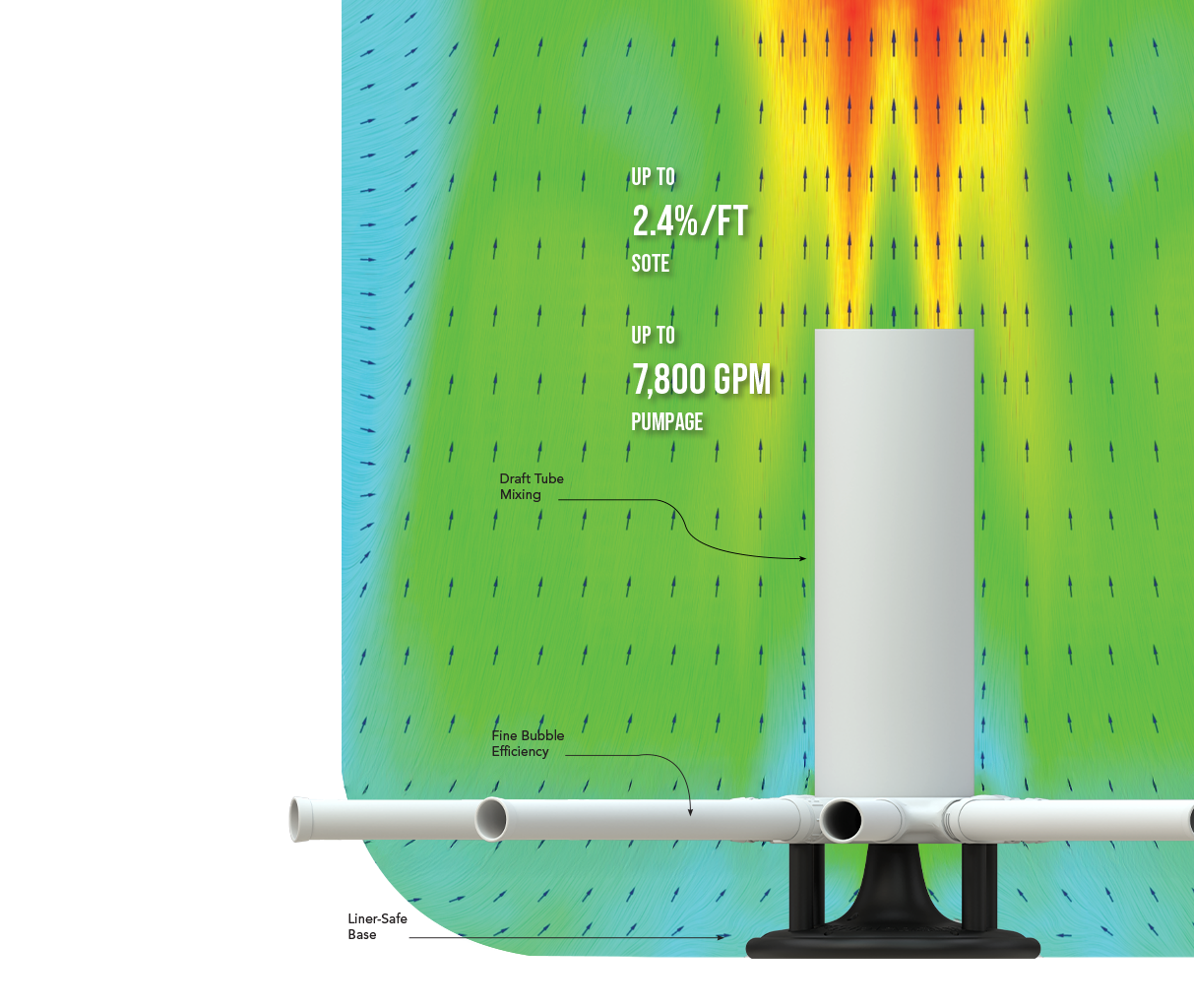
Ares Aeration pairs fine bubble diffusers with a draft tube that moves up to 7,800 gpm per aerator, so oxygen reaches the bottom and the whole water column keeps moving. Aerators install on the lagoon floor without draining the cell, connect to onshore blowers, and can be moved as sludge drifts shrink. We start with your sludge survey and loading data, then size aeration for both oxygen demand and mixing.
Not sure how much sludge you have? Send us your latest sludge survey, or ask us how to run one, and we’ll estimate how much can be reduced in place.
Sources: U.S. EPA, Principles of Design and Operations of Wastewater Treatment Pond Systems (2011); S. Harris, Wastewater Lagoon Troubleshooting: An Operator’s Guide; Triplepoint sludge reduction studies and field data.