

On this page
Aeration is usually the largest operating cost of an aerated lagoon, so it is where the biggest savings are. Most lagoons can cut aeration energy in three ways: run the system for the load they actually receive instead of design capacity, control blowers with variable frequency drives (VFDs) and dissolved oxygen readings, and replace inefficient surface or coarse bubble aerators. The catch is mixing, which treatment depends on as much as oxygen.
Key takeaways
- Most municipal lagoons run at about 50% of design capacity, so aeration sized for design flow wastes energy every day.
- Fine bubble aeration delivers roughly two to five times more oxygen per horsepower than surface aerators.
- Do not save energy at the cost of mixing: the mixing rate sets how much a lagoon can treat.
Where does lagoon energy go?
In an aerated lagoon, blowers or surface aerators use most of the power. They are sized for the design flow and loading 20 years out, plus safety factors, so on most days they supply far more air than the bacteria need. Oxygen demand also changes with the seasons: it is higher in summer, when bacteria are most active, and lower in winter.

How efficient are different lagoon aeration systems?
| Aeration type | Oxygen transfer (clean water) | Mixing | Energy and maintenance |
|---|---|---|---|
| Surface (mechanical) aerators | 1.25–2.25 lb O2/hp-hr | Local | High power; motors serviced on the water |
| Coarse bubble diffusers | Low | Strong | High power; durable |
| Fine bubble diffusers | 4–7 lb O2/hp-hr | Limited | Low power; diffusers foul and need cleaning |
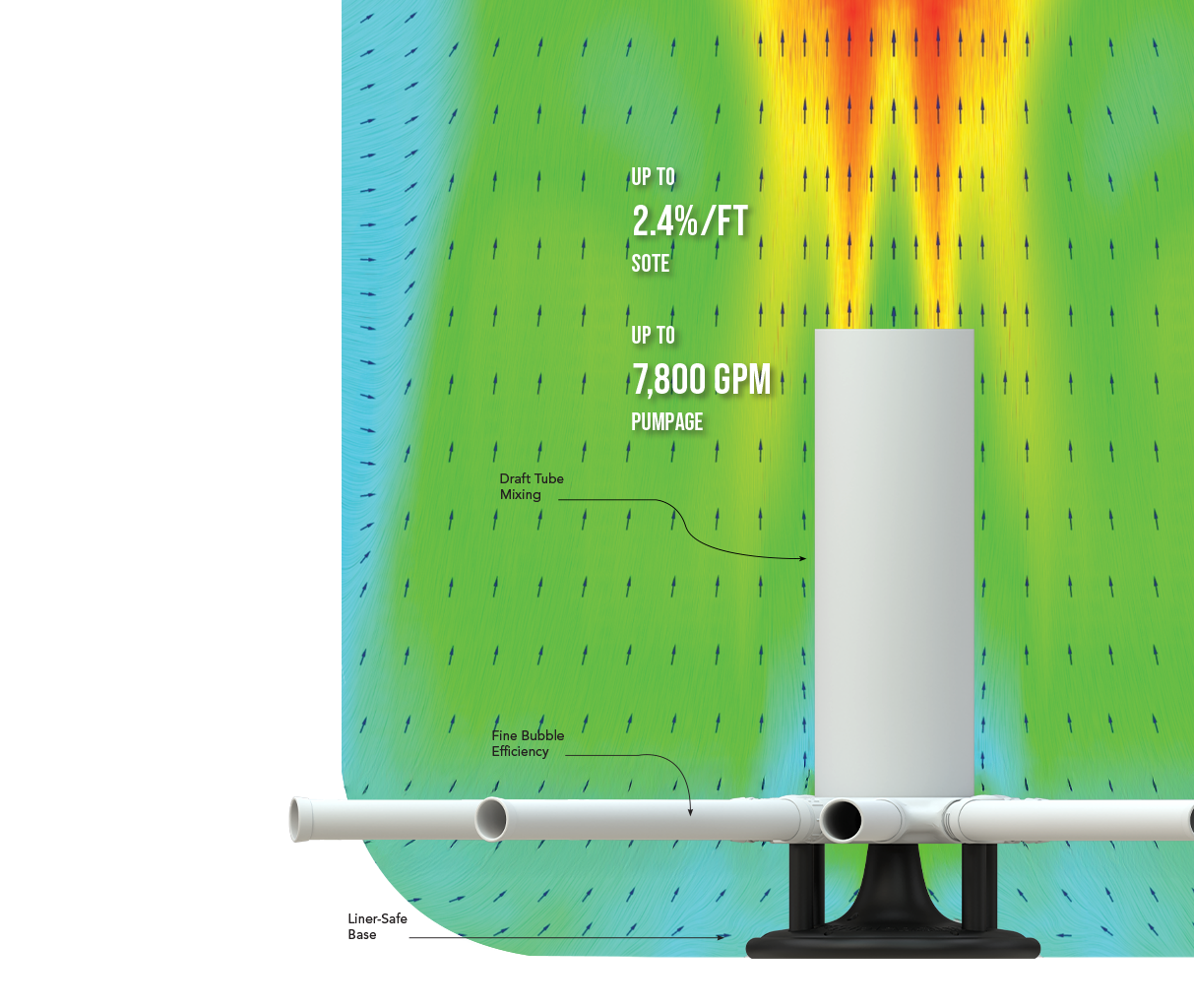
| Fine + coarse bubble (Ares Aeration®) | Up to 2.4% SOTE per ft | Strong (draft tube) | Low power; portable, serviced from shore |
Compare systems on the same basis, and remember that real wastewater transfers less oxygen than clean water (the alpha factor). For a video comparison, see Lagoon aeration 101.
How can you cut lagoon aeration costs?
- Compare design to actual loading. Most lagoons are built for 20-year growth and run at about half of design. Size aeration for today, with room to add later.
- Add VFDs to blowers. Slowing motors when full air is not needed saves energy, especially in winter.
- Control by dissolved oxygen. Hold DO at about 2 mg/L instead of running blowers flat out.
- Turn down seasonally. Winter oxygen demand is lower, so most lagoons can run with less power.
- Replace inefficient aerators. Swapping surface or coarse bubble aerators for fine bubble aeration is usually the single largest saving.
- Keep mixing. Make sure turndown or new equipment still mixes the whole lagoon.
Details and examples: Aerated lagoon optimization to reduce energy consumption and Efficient lagoon aeration.
Why does mixing matter for efficiency?
The EPA describes aeration as having two purposes: supplying oxygen and mixing so bacteria contact the organic matter. The level of mixing determines how fast and how much a lagoon can treat. A system that saves energy but leaves dead zones lets sludge build and treatment slip, so the savings disappear in dredging and permit problems.
How much have lagoons saved?
- Klamath Falls, Oregon: the South Suburban Sanitary District replaced aging coarse bubble diffusers in a 2.7 MGD lagoon and cut electricity and maintenance costs by more than 40%.
- Yerington, Nevada: replacing high-energy, frequently failing floating aerators will save the city almost $500,000 over ten years.
- Danielsville, Georgia: an upgrade using existing blowers and headers doubled aeration efficiency and reduced maintenance.
How much could your lagoon save? Send us your blower or aerator details and a year of power bills, and we’ll estimate savings.
Sources: U.S. EPA, Wastewater Technology Fact Sheet: Fine Bubble Aeration (EPA 832-F-99-065); Ten States Standards (Recommended Standards for Wastewater Facilities); Triplepoint case studies.