

On this page
- What does a lagoon aeration system do?
- What are the types of lagoon aeration systems?
- Partial-mix or complete-mix aerated lagoon?
- How do you size a lagoon aeration system?
- How much energy can a lagoon aeration upgrade save?
- What are the signs a lagoon aeration system needs an upgrade?
- How Triplepoint upgrades lagoon aeration
- Frequently asked questions
A lagoon aeration system does two jobs: it supplies oxygen to the bacteria that treat the wastewater, and it mixes the lagoon so those bacteria stay in contact with their food. The right system does both at the lowest lifetime cost. Fine bubble diffusers transfer oxygen most efficiently, coarse bubble and surface aerators mix best, and hybrid aerators such as Ares Aeration® combine the two.
Key takeaways
- Aeration has to supply oxygen and mix. A system that only does one leaves sludge, odors or high effluent BOD.
- Diffused fine bubble aeration transfers about 4–7 lb O2 per horsepower-hour, compared with 1.25–2.25 for surface aerators, so replacing surface aerators often cuts aeration energy 40–60%.
- Size the system from loading: about 1.5 lb O2 per lb BOD, plus 4.57 lb per lb ammonia-N if the lagoon must nitrify, while holding at least 2 mg/L dissolved oxygen. Then confirm it mixes the whole lagoon.
What does a lagoon aeration system do?
According to the EPA, the purpose of aeration is twofold: to supply the oxygen the microorganisms need, and to mix so they come into contact with the dissolved and suspended organic matter. Both matter, and in a lagoon, mixing often matters more.
Mixing sets how quickly bacteria, oxygen and BOD come together, so it sets how much the lagoon can treat. A system can transfer oxygen very efficiently and still fail if it leaves dead zones. In those quiet areas solids settle, sludge builds, flow short-circuits past the aerators and diffusers clog.
What are the types of lagoon aeration systems?
Most lagoons use one of four approaches. They differ mainly in how efficiently they transfer oxygen, how well they mix, and how hard they are to maintain.
| Type | How it works | Oxygen transfer | Mixing | Maintenance |
|---|---|---|---|---|
| Surface (mechanical) aerators | Floating motors splash water into the air or push air below the surface | 1.25–2.25 lb O2/hp-hr | Strong near each unit; dead zones between them and in deep water | Motors sit on the water and are serviced by boat, typically twice a year; prone to icing |
| Fine bubble diffusers (disc, tube or perforated tubing) | Onshore blowers push air through membranes on the lagoon floor | 4–7 lb O2/hp-hr; 1.8–2.2% SOTE per foot of depth | Limited; each diffuser influences roughly 20–25 ft | Diffusers foul and need cleaning; fixed laterals require draining the cell |
| Coarse bubble diffusers | Large bubbles from open orifices or static tubes | Low | Strong | Durable and resistant to clogging, but energy-hungry |
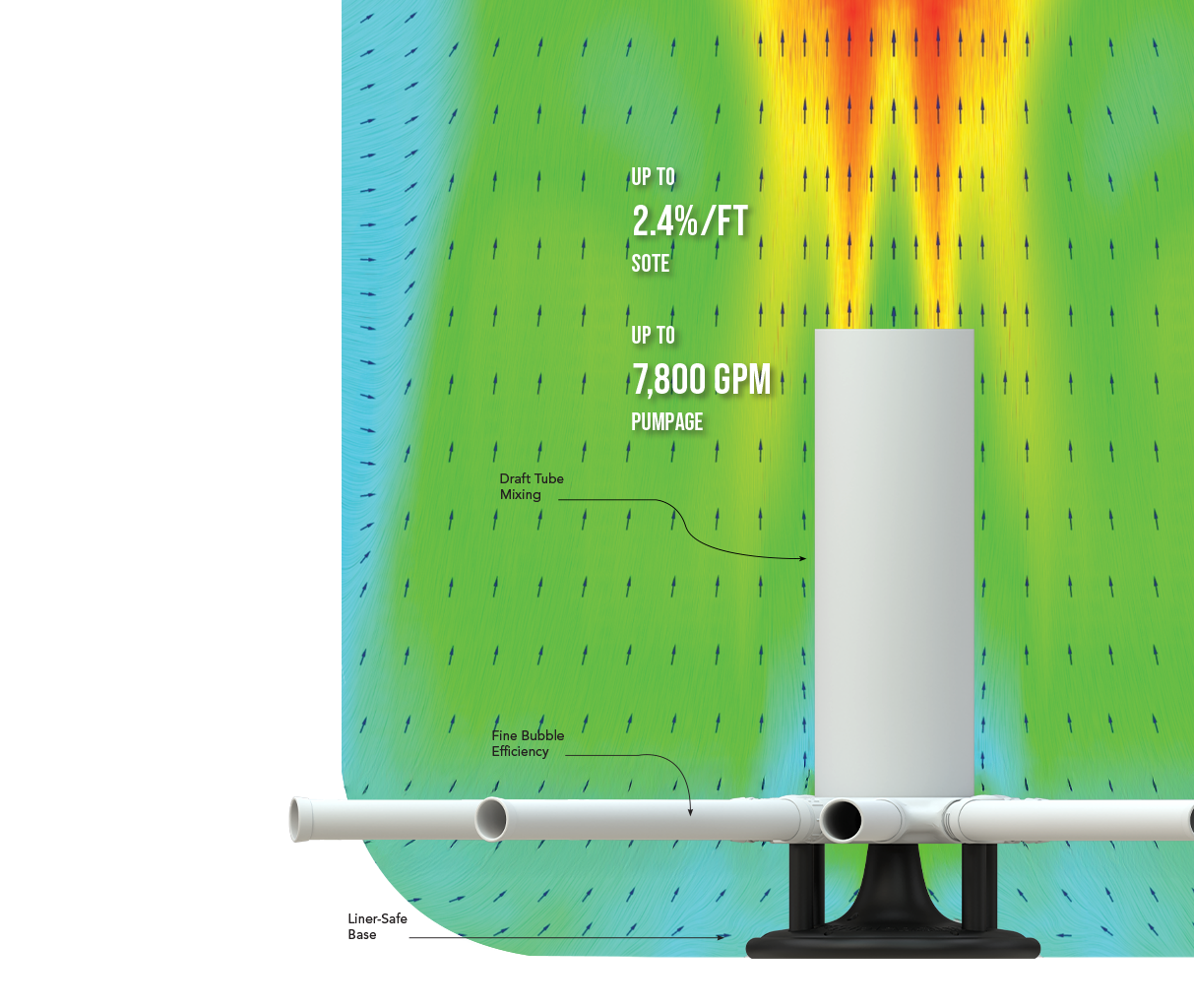
| Hybrid fine + coarse bubble (Ares Aeration) | Fine bubble diffusers inside a draft tube that circulates water | Up to 2.4% SOTE per foot of depth | Up to 7,800 gpm of pumpage per aerator; mixes up to 125 ft across | Portable; units are lifted out for service without draining |
Oxygen transfer figures are clean-water ratings. Real wastewater transfers less (the alpha factor), so compare systems on the same basis. For detail on each type, see fine bubble aeration pros and cons and surface aeration pros and cons.
Partial-mix or complete-mix aerated lagoon?
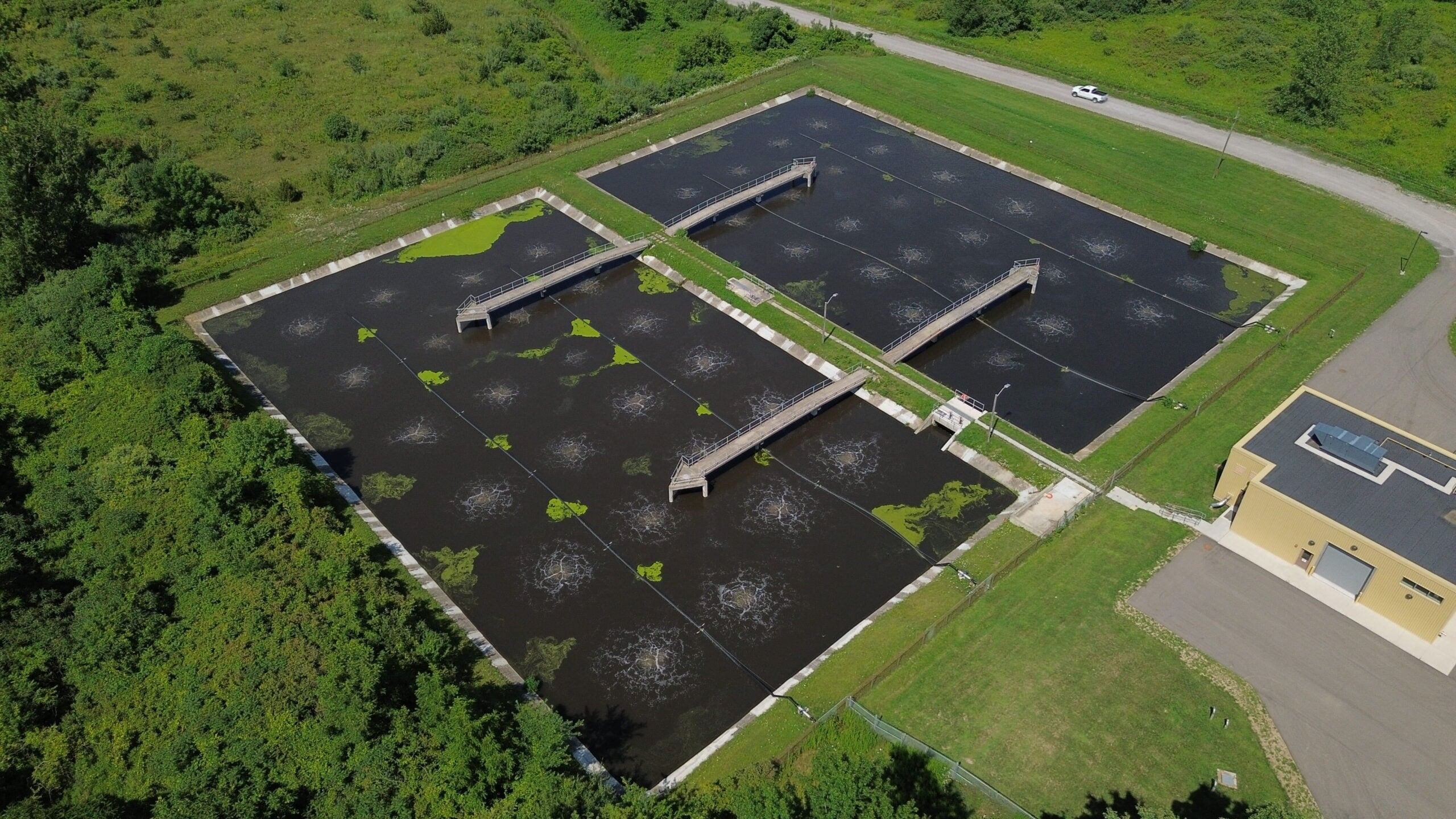
Most aerated lagoons in the U.S. are partial-mix: aeration supplies the oxygen for treatment but lets some solids settle and digest slowly on the bottom. A complete-mix lagoon keeps all solids suspended, so they digest much faster and the same footprint treats more, but it needs more horsepower and settling afterward.
| Partial-mix | Complete-mix | |
|---|---|---|
| Solids | Some settle and are stored as sludge | All kept in suspension |
| Power | Lower | Higher |
| Treatment in the same footprint | Lower; longer retention | Higher; behaves like activated sludge without recycle |
| Sludge | Accumulates; eventually removed | Little bottom sludge; settle downstream |
| Typical use | Most municipal lagoons | Capacity expansions, equalization basins, industrial loads |
Converting part of a lagoon to complete mix is one of the cheapest ways to add capacity. See partial-mix vs. complete-mix design.
How do you size a lagoon aeration system?
- Collect the data: lagoon dimensions and depth, average and peak flow, influent BOD, TSS and ammonia, permit limits, sludge depth, site elevation and water temperature range.
- Calculate the oxygen demand: about 1.5 lb O2 per lb BOD, plus 4.57 lb O2 per lb ammonia-nitrogen if the lagoon must nitrify.
- Convert to air flow using the diffuser’s transfer efficiency, water depth, alpha factor, temperature and elevation.
- Check mixing: aerator areas of influence should overlap so there are no dead zones, especially near the effluent.
- Compare lifetime cost: capital, power and maintenance for partial-mix and complete-mix options.
Example: a lagoon treating 0.5 MGD at 200 mg/L BOD and 25 mg/L ammonia-N needs roughly 1,730 lb of oxygen per day. The full calculation and common pitfalls are in Lagoon aeration system design.
How much energy can a lagoon aeration upgrade save?
Energy is usually the largest operating cost of an aerated lagoon, and the type of aeration drives it. Because diffused aeration delivers roughly two to five times more oxygen per horsepower than surface aerators, replacing surface aerators or old coarse bubble systems commonly cuts aeration energy 40–60%. Ares Aeration delivers up to 60% energy savings over standard lagoon aeration equipment.
Maintenance falls too. In Parsons, West Virginia, eight surface aerators were replaced with Triplepoint fine and coarse bubble aeration run by two onshore blowers, reducing energy and maintenance costs by 60%.
What are the signs a lagoon aeration system needs an upgrade?
- Dissolved oxygen below 2 mg/L, or large swings between afternoon and night
- Odors, gray or black water, or rising and floating sludge (turnover)
- Effluent BOD, TSS or ammonia creeping toward permit limits
- Rising blower pressure, clogged diffusers or failed laterals
- Surface aerators that break down often or ice up in winter
- Power bills that keep climbing while treatment does not improve
Low DO has many causes beyond the aerators. See lagoon dissolved oxygen for a troubleshooting list.
How Triplepoint upgrades lagoon aeration
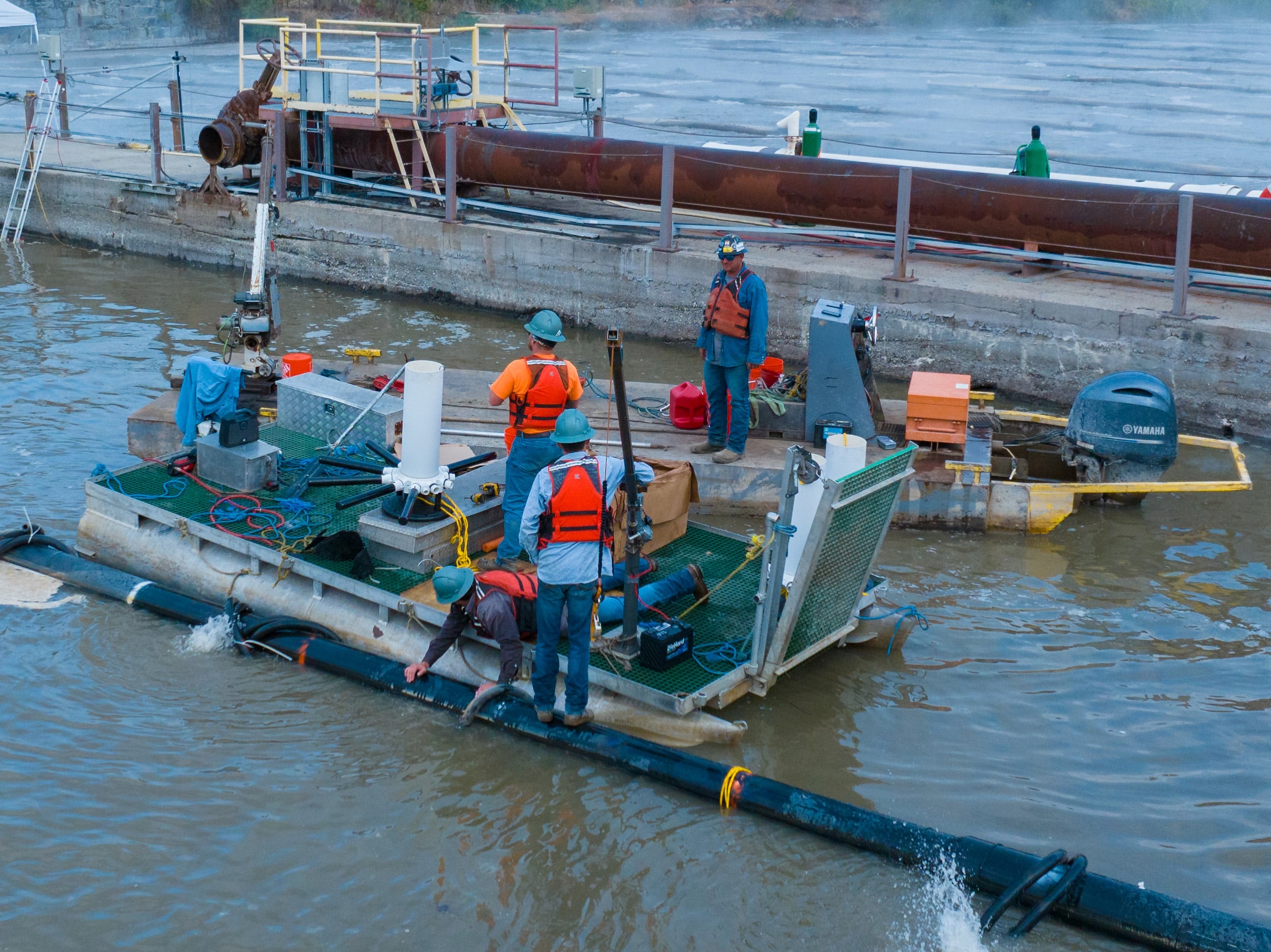
Ares Aeration combines fine bubble diffusers with a draft tube, so one aerator transfers oxygen efficiently and mixes the full water column. Aerators sit on the lagoon floor, connect to onshore blowers by flexible air lines, and lift out for service, so most retrofits keep existing blowers and headers and never drain the cell. Ares is BABA compliant, and every installation is backed by Triplepoint’s Technology Performance Guarantee.
- Pacific, Missouri: a 1 MGD partial-mix lagoon replaced flood-damaged rigid fine bubble tubing with 99 aerators, keeping its existing blowers and air header.
- La Grande, Oregon: a failing coarse bubble system in a 3.5-acre cell was replaced in two days and the lagoon returned to compliance.
- Tulelake, California: replacing coarse bubble aeration cut energy use and produced effluent for irrigation reuse.
Is your aeration system sized for today’s loading? Send us your lagoon dimensions, flow and power use, and we’ll model partial-mix and complete-mix options.
Sources: U.S. EPA, Wastewater Technology Fact Sheet: Fine Bubble Aeration (EPA 832-F-99-065); U.S. EPA, Principles of Design and Operations of Wastewater Treatment Pond Systems (2011); S. Harris, Wastewater Lagoon Troubleshooting: An Operator’s Guide; Triplepoint field data and case studies.